
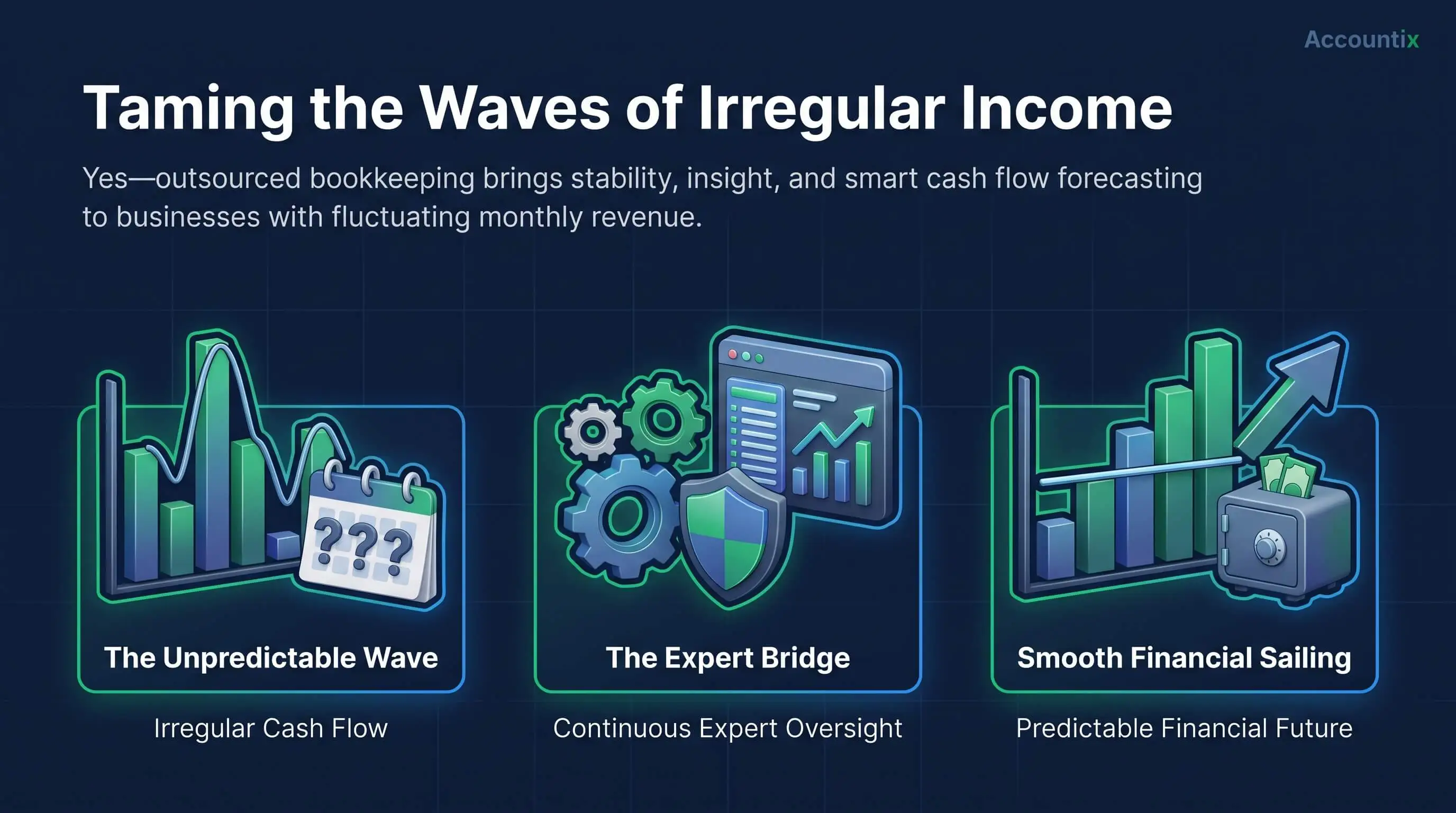
Payroll runs on the 15th whether your biggest client paid in May or not. Outsourced bookkeeping can't move that date, but it can show you weeks ahead whether the money will be there. So yes, it helps a business with irregular monthly income, just not by making the income steadier.
Picture a small agency in an ordinary quarter. A retainer client pauses for a budget review, and the big project that wrapped in May won't pay until July because the invoice said net-60. The business is profitable on paper and tight in the checking account. Anyone who has looked closely at agency owner income knows this rhythm well.
Accountix, a Santa Barbara outsourced accounting firm founded in 2015, closes the books every month for more than 150 clients nationwide. Across roofing contractors, creative studios, wineries and nonprofits, the team keeps running into the same thing: the owners who handle lumpy revenue best rarely have the steadiest clients, but they do know their numbers before the slow month shows up. That habit is what well-run outsourced bookkeeping services are set up to build.
TL;DR Quick Answers
Outsourced Bookkeeping Services
Outsourced bookkeeping services put your recording, reconciling and monthly reporting with an outside team, so your books close every month without another in-house hire.
What's included: transaction management, bank and card reconciliations, accounts payable and receivable, payroll categorization, and a monthly close with financial reports.
What it isn't: budgets and cash flow forecasts. Those belong to outsourced accounting or a fractional CFO.
Why it helps with irregular income: reconciled books show your monthly floor, so you plan from numbers instead of the bank balance.
What it costs: Accountix bookkeeping starts at $200 per week, priced fixed and scoped to transaction volume and complexity.
What to ask any provider: does the price include a monthly close? Categorizing transactions without reconciling them is data entry, not bookkeeping.
Top Takeaways
Bookkeeping makes uneven income visible, not steady. Outsourced bookkeeping services show you the gap before it hits.
Know your monthly floor. Calculate fixed obligations from reconciled statements, not memory.
Track receivables like inventory. Money owed to you is your most important forecast input.
Size your reserve in cash buffer days. Fund it with a fixed share of every strong month.
Step up when you need to look forward. Budgets and cash forecasts belong to outsourced accounting, not basic bookkeeping.
Why Irregular Income Is a Bookkeeping Problem Before It Is a Revenue Problem
Profit and cash rarely arrive in the same month. You can finish a project in March, book the revenue, and not see the payment until May. Rent and payroll leave on schedule regardless.
That's why the accounting method matters more than most owners expect. Cash-basis books record money when it moves, so they tell you whether you can cover next week. Accrual-basis books record revenue when it's earned, which makes them the better test of whether the business is actually performing. With uneven income you need both views, because a healthy business can still miss payroll.
The picture gets murkier when personal and business spending share accounts. If you're still mixing personal and business funds, nobody can tell you what the business actually costs to run each month, and every planning decision rests on a guess.
What Outsourced Bookkeeping Services Actually Do When Revenue Swings
Good outsourced bookkeeping services take a messy stream of deposits and bills and turn it into numbers you can plan around. For a business with uneven income, that work pays off in a few specific places.
Reconciled Books Show Your Real Monthly Floor
Your floor is what the business must pay every month whether revenue shows up or not: payroll, rent, software, insurance, loan payments. Monthly reconciliation matches every bank and card account to the books, so that number comes from bank records instead of memory. Once you know your floor, a slow month turns into a gap with a dollar figure attached, and you can decide ahead of time how to cover it.
Receivables Tracking Shows What Is Coming and When
When income is irregular, the money customers owe you is your most important forecast input. A bookkeeper tracks open invoices, records payments as they land, and flags what is running late. On the other side of the ledger, scheduling bills through tools like BILL or Ramp lets you time outflows to inflows without missing the terms you negotiated.
A Monthly Close Turns Activity Into Decisions
Categorizing transactions all month accomplishes little if nobody closes the books. At close, the bookkeeper reconciles every account and checks the entries before sending financial statements on the same date each month. For an owner with lumpy revenue, that report is the difference between deciding in week two of a slow quarter and discovering the problem at tax time.
How to Build a Cash Reserve From Reconciled Numbers
A reserve only protects you if it's sized from accurate books. Here's the order Accountix recommends:
Get three to six months of reconciled financial statements.
Calculate your monthly floor from those statements, not from memory.
Set a reserve target in cash buffer days or months of floor. Cash buffer days are the number of days a business could keep paying its normal outflows if all income stopped.
Move a fixed percentage of every strong month into a separate reserve account, before it gets spent.
Review the target at each quarterly close as your costs change.
The number doesn't have to be perfect. It has to come from your books, so a slow month draws down a plan instead of setting off a scramble.
Handling Taxes When Income Arrives Unevenly
Income spikes create tax surprises. A strong quarter can push estimated tax obligations up at exactly the moment cash feels plentiful, and the bill lands after the money is gone.
Two habits help. First, set aside a portion of every large deposit for taxes in a separate account. Second, ask your CPA about the IRS annualized income installment method, explained in IRS Publication 505, which can match estimated payments to the periods when income was actually earned rather than spreading it evenly. Your bookkeeper keeps the records current so your CPA can make that call. Accountix works directly with clients' tax professionals, but it doesn't file taxes or stand in for your CPA.
Where Bookkeeping Stops and Forecasting Begins
This is where honest providers draw a line. Bookkeeping records, reconciles, and reports what already happened. Budgets and cash flow forecasts look forward, and that work belongs to outsourced accounting or, for strategic questions, a fractional CFO. If pricing, margins, or hiring decisions are on the table, it helps to understand how a CFO improves margins in a service business.
Do it yourself: You reconcile accounts when you find time, track receivables in a spreadsheet or your head, and rarely see a monthly report. Forecasting is guesswork. The cost is your evenings plus software fees.
Outsourced bookkeeping: Your bookkeeper reconciles bank and card accounts every month, tracks and records open invoices, and sends financial reports on a fixed schedule. Budgets and cash flow forecasts aren't part of this tier. At Accountix, it starts at $200 per week.
Outsourced accounting: Your accounting team handles everything bookkeeping covers, then adds a second review of reconciliations, manages the invoice workflow to steady cash, customizes performance reports, and builds budgets and cash flow forecasts. At Accountix, it starts at $350 per week.
Many businesses with irregular income start with bookkeeping and stay there for years. Step up when you need to know next quarter, not just last month.
Signs Your Irregular Income Needs Outside Help
Your books get reconciled once a year, at tax time.
You make spending decisions from the bank balance.
You can't say, today, how much customers owe you.
Estimated tax payments catch you off guard.
You spend nights categorizing transactions instead of running the business.
A slow month feels like an emergency every time.
"In more than ten years of closing books for project-based businesses, we've rarely seen irregular income do the damage on its own. The damage usually comes from not knowing the floor. When we take over a new client's books, we tend to find a few months of unreconciled accounts and a reserve somebody guessed at. Once the books close every month, a slow quarter becomes a number the owner already planned for."
7 Essential Resources
These sources cover the survey data and tax rules behind this article, plus the basic reporting every owner with uneven revenue should be able to read. Use them to check your own setup, or any provider you hire.
1. Federal Reserve Banks, 2026 Report on Employer Firms The Fed's annual small business survey tracks the financial challenges owners report, including rising costs and borrowing to cover operating expenses. It's a useful reality check: if your cash flow feels uneven, you're in large company.
2. JPMorgan Chase Institute, Cash is King: Flows, Balances, and Buffer Days This study introduced cash buffer days as a way to measure how long a small business could keep paying its bills if income stopped. It gives you a concrete yardstick for sizing a reserve.
3. IRS Publication 505, Tax Withholding and Estimated Tax The IRS explains how estimated taxes work, including the annualized income installment method for income received unevenly during the year. Read it before your next quarterly payment, then confirm your approach with a CPA.
4. U.S. Small Business Administration, Manage Your Finances The SBA compares cash and accrual accounting and lists the items someone in your business must manage: receivables, payables, available cash, bank reconciliation, and payroll. It's a short, plain-language checklist.
5. IRS Publication 583, Starting a Business and Keeping Records This guide covers which business records to keep and for how long. Organized records are the base of any reserve plan or tax strategy.
6. U.S. Securities and Exchange Commission, Beginners' Guide to Financial Statements The SEC walks through the balance sheet, income statement, and cash flow statement, and how they connect. Knowing how to read all three helps you judge whether your monthly reports are complete.
7. SCORE, Financial Statements Templates SCORE offers free templates for cash flow statements and other reports. They are a practical starting point if you are building your first monthly reporting routine.
3 Statistics
1. More than half of small employer firms struggle with uneven cash flow. In the Federal Reserve Banks' 2025 Report on Employer Firms, based on the 2024 Small Business Credit Survey, 51% of firms cited uneven cash flows as a financial challenge and 56% cited paying operating expenses. Irregular income is the norm, not a personal failing.
2. The typical small business could cover only about four weeks of outflows. The JPMorgan Chase Institute's 2016 study found the median small business held 27 cash buffer days, and a quarter held fewer than 13. Reconciled books are how you find out which side of that line you sit on.
3. Borrowing to cover operating costs is common. According to the Federal Reserve Banks' 2026 Report on Employer Firms, which surveyed 6,525 firms in 2025, 56% of businesses that sought financing did so to meet operating expenses. Better visibility into cash timing can reduce how often a slow month turns into a loan application.
With 51% of small businesses facing uneven cash flow, a median cash reserve of just 27 days, and 56% of financing applicants seeking funds for operating expenses, maintaining accurate financial records and managing cash flow are essential. For businesses investing in multicultural marketing to reach diverse audiences, understanding cash flow and planning expenses carefully can help support sustainable growth without adding unnecessary financial pressure.
Final Thoughts and Opinion
Outsourced bookkeeping won't flatten an uneven revenue curve. Clients will still pause and invoices will still pay late. What changes is how early you see it coming. With reconciled books and a monthly close, irregular income stops feeling like a recurring emergency and starts looking like a pattern you can plan around.
Some of what follows is opinion, and it's opinion the Accountix team would defend in front of any owner:
Aim to smooth your decisions rather than your income. You can't control when clients pay, but you can control whether you decide from a report or from a bank balance.
A reserve sized by guesswork is just a savings account with a hopeful name. Size it from reconciled statements and revisit it at every quarterly close.
Don't buy forecasting before your books reconcile. A forecast built on messy books is fiction with a spreadsheet attached.
A monthly close beats an annual cleanup every time. A problem caught in month two costs a phone call, while the same problem found in month eleven usually means paying for a cleanup.
Almost every business with clients lives with irregular income, but not knowing your floor is optional. For nonprofit organizations facing similar financial challenges, outsourced accounting for nonprofits can help maintain financial stability and improve cash flow visibility.
Frequently Asked Questions
Can outsourced bookkeeping help a business with irregular monthly income?
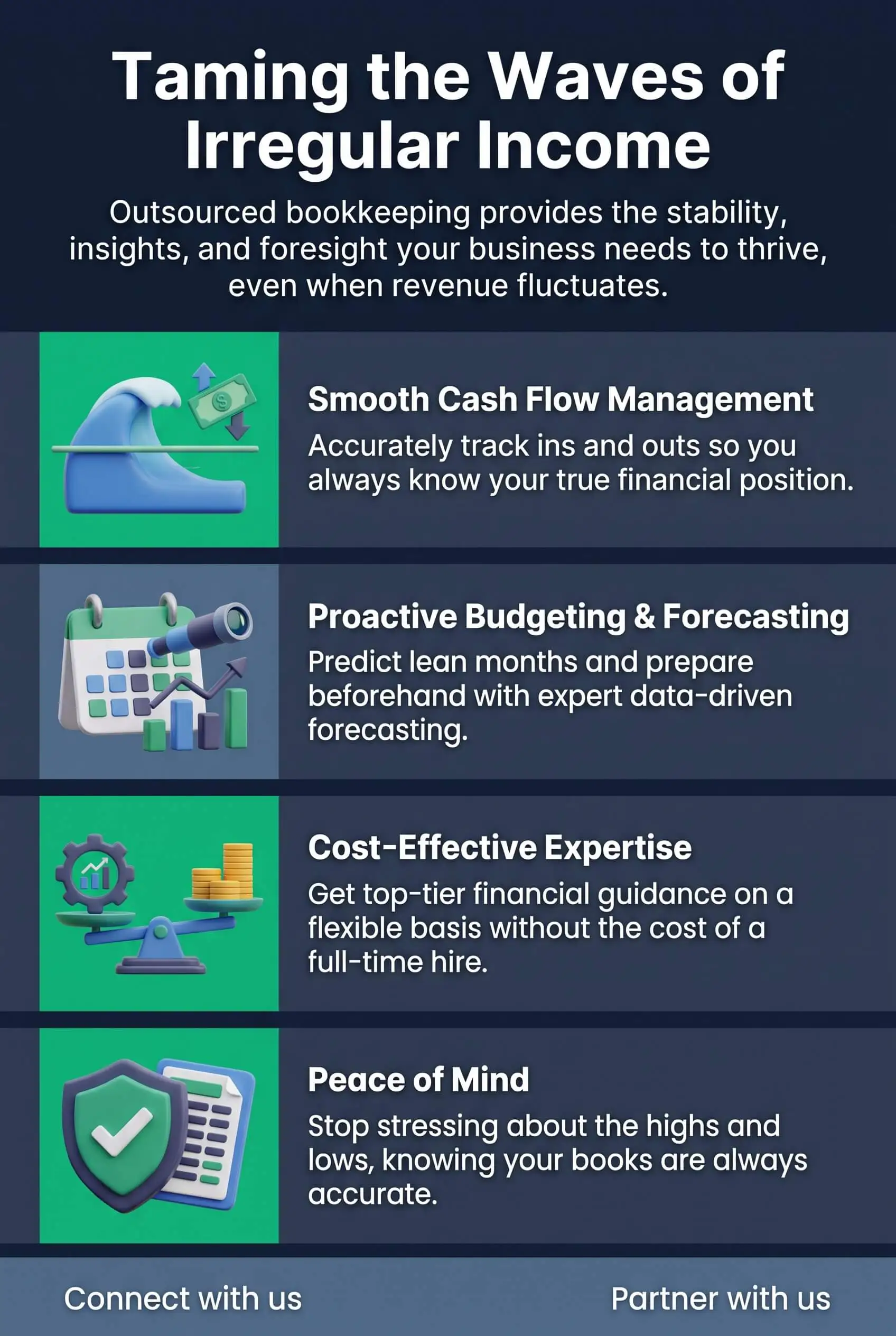
Yes, though it works by making uneven income manageable rather than steadier. Monthly reconciliation shows your true fixed costs, receivables tracking shows what's coming in and when, and a monthly close delivers reports in time to act. Together, those let you plan from a known floor instead of reacting to the bank balance.
How much do outsourced bookkeeping services cost?
Pricing usually depends on transaction volume, complexity, and how often the books are updated. At Accountix, outsourced bookkeeping services start at $200 per week, and outsourced accounting, which adds budgeting and forecasting, starts at $350 per week. Ask any provider what is included in the quoted price and what would change it.
What is the difference between bookkeeping and cash flow forecasting?
Bookkeeping tells you what has already happened. Cash flow forecasting uses those records to project what will happen over the coming weeks or months. Forecasting depends on clean books, which is why most businesses start with bookkeeping and add forecasting through outsourced accounting or a fractional CFO.
How much cash reserve should a business with uneven income keep?
No single number fits every business, so measure it against your own monthly floor. Many owners aim for several months of fixed costs. For context, a JPMorgan Chase Institute study found the median small business held just 27 cash buffer days. Size your target from reconciled statements and review it every quarter.
Should a business with irregular income use cash or accrual accounting?
Each answers a different question. Cash-basis reporting shows whether you can pay upcoming bills. Accrual reporting shows whether the business actually made money in a given period. Businesses with lumpy revenue benefit from seeing both. Your tax filing method is a separate decision to make with your CPA.
How do estimated taxes work when business income is uneven?
Most owners pay estimated taxes in quarterly installments. When income arrives unevenly, the IRS annualized income installment method, described in Publication 505, may let you match payments to when income was earned. Keep current books so your CPA can calculate it, and set aside a share of every large deposit.
Get Your Floor in View
If slow months keep catching you off guard, start with the numbers. Book a 30-minute intro call with Accountix, and the team will look at your current books and recommend the right level of support for a business with uneven income. There's no obligation, and you'll leave knowing where you stand before the next slow month arrives.


