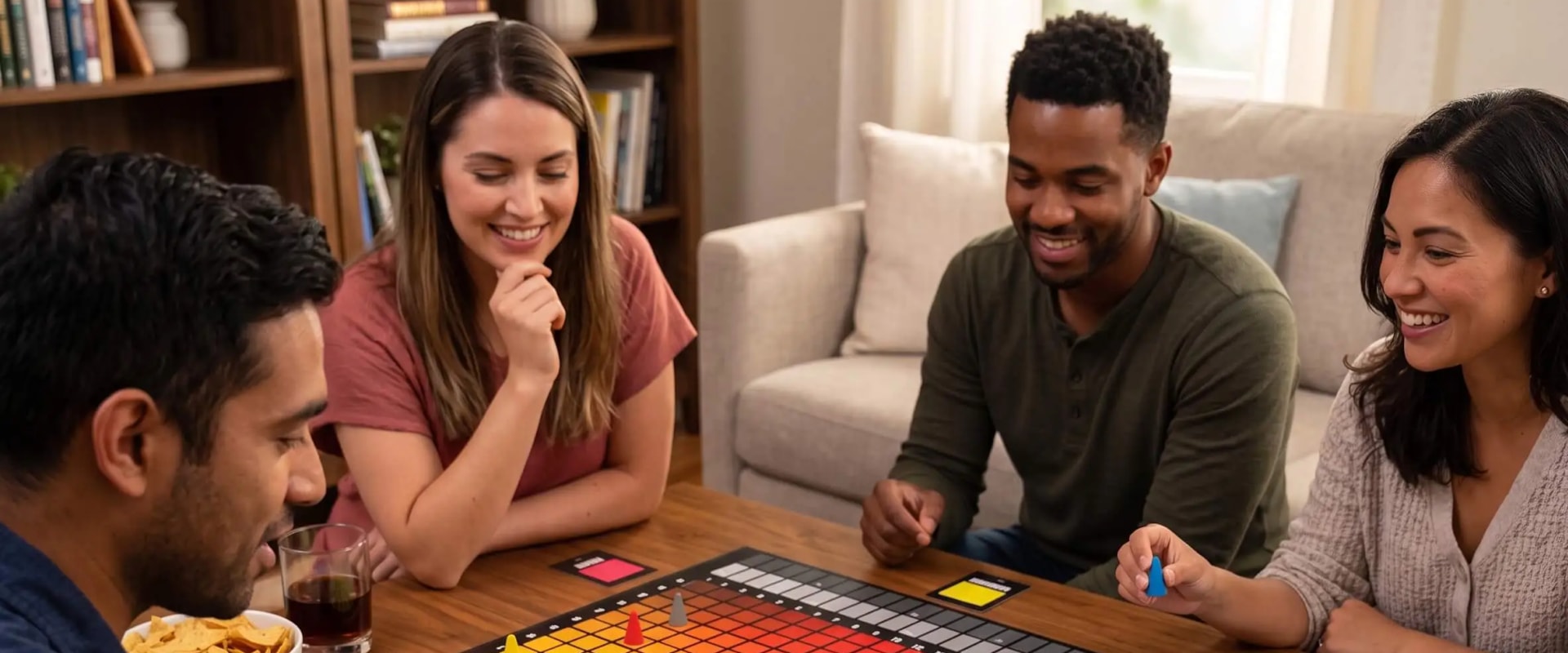
Five minutes is all it takes to set up the Hues and Cues game, and I've timed it across enough game nights to know. What slows new players down isn't the setup itself but the second-guessing that comes with it, the rulebook open on the table, four friends waiting, nobody quite sure where the scoring frame goes. You can skip all of that. Below is the whole setup in order, plus the handful of mistakes that trip up new groups, so your first round starts clean and stays fun.
TL;DR Quick Answers
Hues and Cues game
Hues and Cues is a color-guessing party game for 3 to 10 players, ages 8 and up, and a full game runs about 30 minutes. One player secretly picks a color from a board of 480 shades and describes it with only one or two words, while everyone else places a marker on the shade they think matches. The closer your guess, the more points you score.
Quick facts:
Players: 3 to 10
Age: 8 and up
Play time: about 30 minutes
Designer and publisher: Scott Brady, The Op (2020)
Object: guess close to the target color, and give cues your group can read
What makes it land is how differently people picture the same word. One player hears "coffee" and thinks espresso-dark, the next pictures it with milk, and that gap is where the laughs come from. After plenty of game nights, it's the first thing I'd tell a new player to expect.
Top Takeaways
If you remember nothing else, remember these.
Setup runs about five minutes once the board's centered, the cones are out, the frame's built, and the cards are shuffled.
Build the scoring frame during setup, not mid-round.
Cues can never be color names. Describe what the color brings to mind.
The game fits 3 to 10 players, ages 8 and up, and runs about 30 minutes.
It stays fair for colorblind players, because it rewards description over exact color matching.
What's in the Box
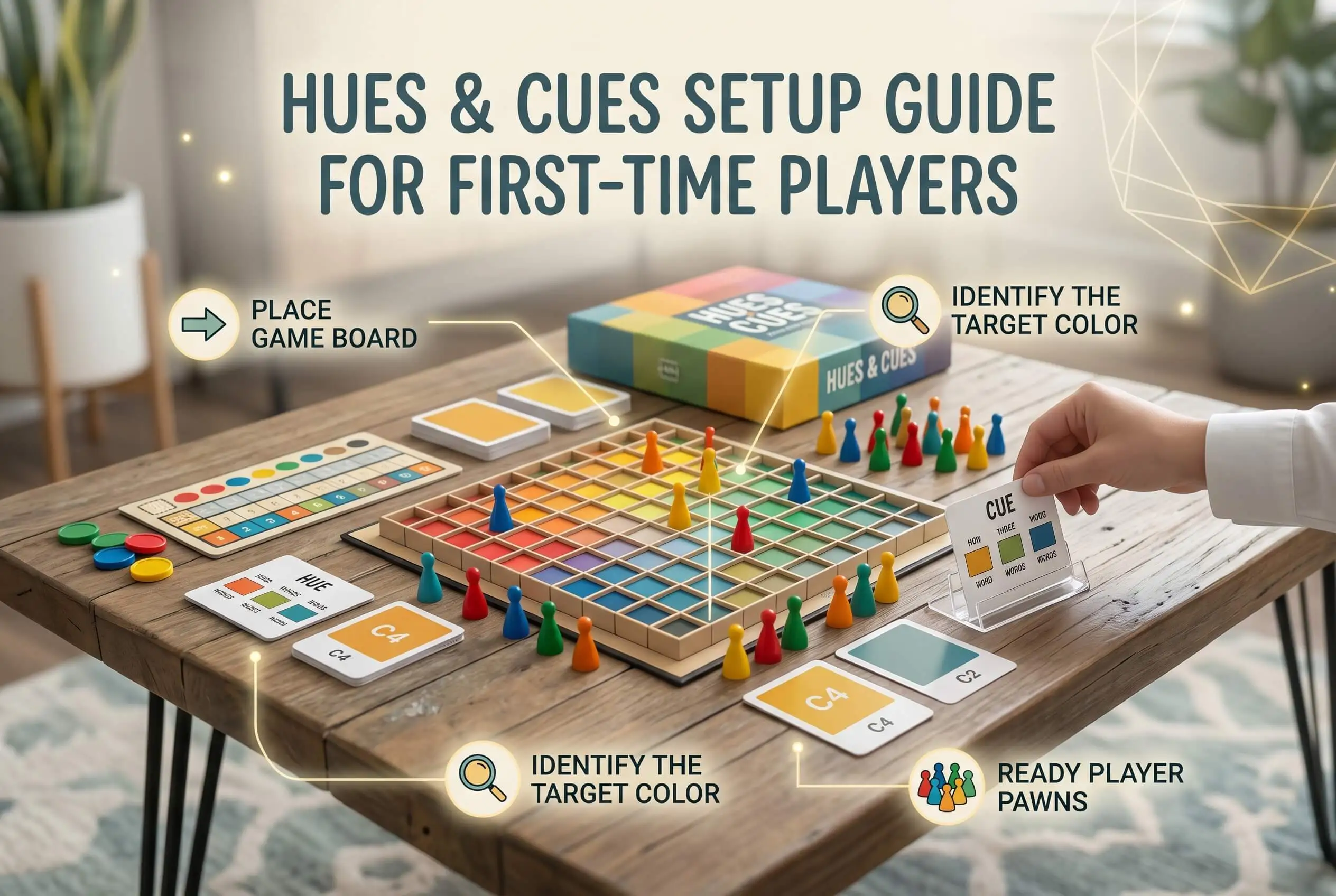
Open the box and lay everything out before you do anything else. You're looking for five things: a large fold-out board printed with a grid of 480 color squares, a deck of color cards, a set of small cones in a range of colors, a cardboard scoring frame that comes flat in pieces, and the rulebook. Each player will use three cones to mark their guesses. Take ten seconds to recognize each part now. That small habit is the difference between a smooth setup and digging through the box for the scoring frame halfway through a round.
How to Set Up Hues and Cues, Step by Step
Here's the full setup in order. None of it is hard, and after one game you won't need the list.
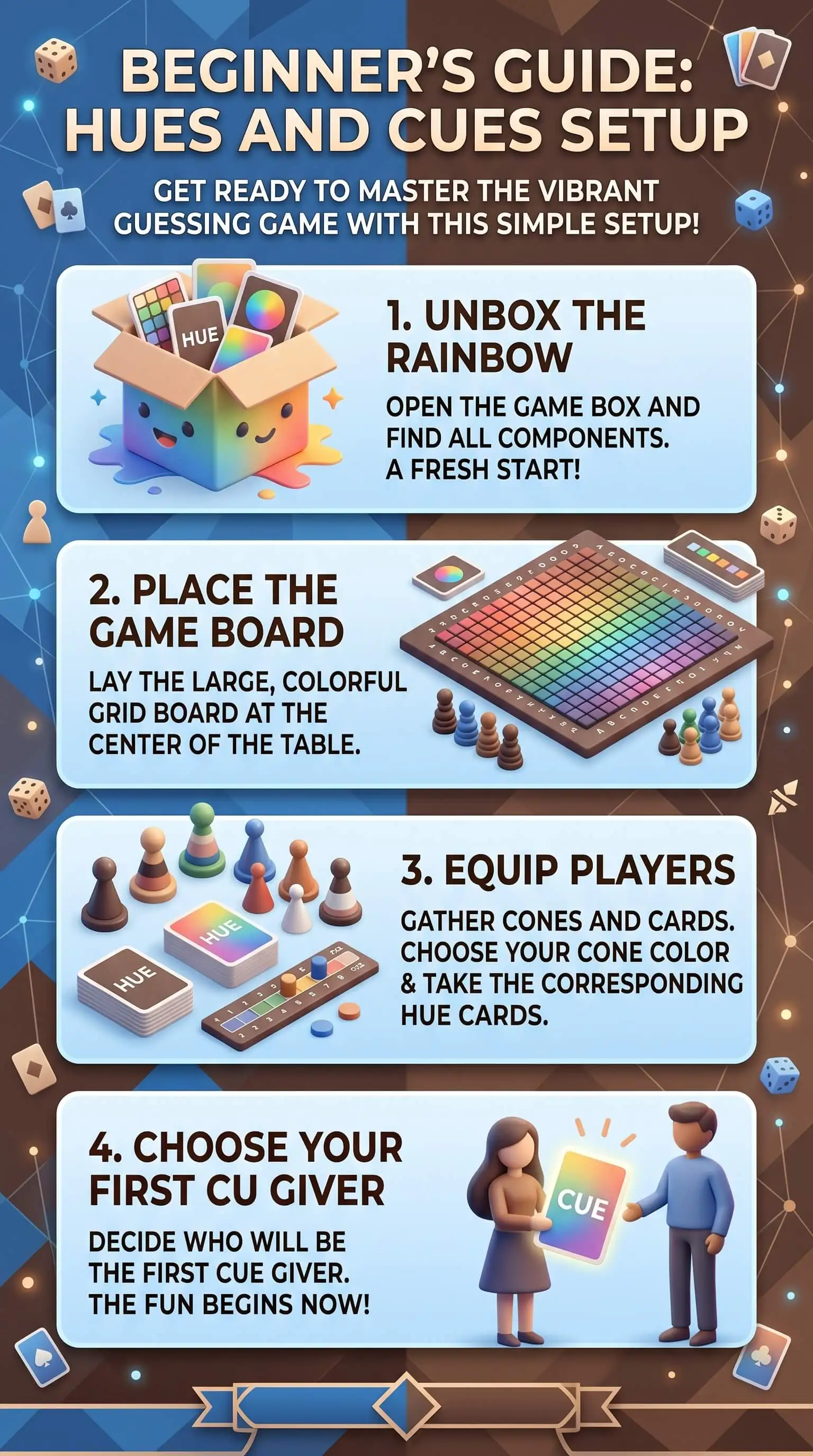
Step 1: Place the Board in the Middle
Unfold the board and put it in the middle of the table, somewhere every player can reach. This matters more than it sounds. People lean in constantly to set cones on exact squares, so give the board room and keep it clear of a wall or the snack bowls.
Step 2: Hand Out the Player Cones
Each player picks a color and takes three cones in it. Two stay in front of them to guess. The third sits on the start of the score track along the board's edge, and that one tracks points all game. If you have more players than cone colors, sharing a color works fine and is common with a big group.
Step 3: Assemble the Scoring Frame
The scoring frame comes flat, a few cardboard pieces that slide into an open square. Build it now, before anyone draws a card. It stays assembled afterward, so this is a one-time job. Set it next to the board where you can grab it fast.
Step 4: Shuffle and Place the Color Cards
Shuffle the color card deck well and set it face down beside the board. Every card shows four color swatches with grid coordinates. The cue giver draws one card each round, so keep the deck somewhere reachable, not across the board from half the table.
Step 5: Choose the First Cue Giver
Someone has to go first. The rulebook's suggestion, and it's a good one, is that whoever's wearing the most colorful outfit takes the opening turn as cue giver. Any method works, but that one always gets a laugh. After round one, the role moves around the table.
Step 6: Run a Quick Rules Recap
Before anyone draws a card, spend sixty seconds on the one rule that trips up new players. Cues can never be color names. Nobody can say “blue” or “navy.” You describe what the color brings to mind instead. That quick recap saves a round's worth of confusion.
How a Round Works in 30 Seconds
Setup makes more sense once you know where it leads. So here's a round, fast. The cue giver draws a card and secretly picks one of its four colors. They give a one-word cue, something the color brings to mind, like “sunrise” or “denim,” and everyone else places a cone on the square they think matches. Then comes a second cue, one or two words, and a second cone. The cue giver reveals the color, drops the scoring frame over it, and everyone counts the points. The closer your cone sits to the target, the more you score. The cue giver scores too. That shared interpretation is part of what makes the game so engaging, and it’s the same kind of emotional connection smart DnD and TTRPG Marketing tries to create when introducing players to a new world or campaign. Play moves around the table until everyone has taken their turns.
First-Game Mistakes Worth Avoiding
I've taught this game to a lot of new groups, and the same small stumbles come up every time. Here's what to watch for.
Leaving the scoring frame in pieces. The first time my group played, we hadn't built the frame and had to scramble for it mid-round. Build it during setup.
Reaching for color names as cues. “Light blue” isn't a legal cue, but new cue givers say it on instinct. Describe a feeling or an object instead.
Crowding the board. If players can't reach every square comfortably, the guessing gets sloppy. Clear the table and center the board.
Overthinking the first cue. New cue givers often pick something so clever that nobody lands close. For a first game, keep cues honest and everyday.
Forgetting the score-track cone. It's easy to hand out the guessing cones and forget the one that tracks points. Place it on the track at the start.
Skipping the easy variant. With younger kids at the table, the rules let you allow shade names like “teal” as cues, which makes the game far kinder to them.
"Nobody tells first-time hosts that setup is also the teaching moment. While you're handing out cones and building the scoring frame, you're showing everyone how the game feels before a single card is drawn. I talk the first round throughout loud as I set up, so the rulebook never has to come back out. Years of game nights have taught me one pattern. The groups who set up together, instead of watching one person do it, are the ones still playing three rounds later."
Essential Resources
When a rules question comes up mid-game, or you just want to read more, these are the seven references I keep handy.
The Op's official Hues and Cues page is the publisher's own listing, with current edition details and where to buy.
The Hues and Cues page on BoardGameGeek collects player ratings, reviews, and busy forums where rules questions get answered.
The official rulebook PDF gives you the full rules, which helps when a specific scoring question comes up.
The BoardGameGeek how-to-play video is a short visual walkthrough for anyone who learns better by watching.
Asmodee's how-to-play guide is a clean written walkthrough of setup and play from the game's distributor.
Geeky Hobbies' rules breakdown is a thorough third-party guide with the clearest take on scoring.
Happy Piranha's quick-start guide is a short how-to, handy for a fast refresher before game night.
Supporting Statistics
A little context for the hobby you've just joined.
The hobby is busy. Industry analysts put the global board games market at about 12.2 billion dollars in 2024, with growth expected to continue through 2034. You've joined a hobby plenty of other people are spending their evenings on too.
Party games are a big slice of that. Compiled board game sales data puts party and family games at around 22 percent of the market, one of its largest categories. Hues and Cues sits right in that crowd-pleasing group.
Color vision varies more than most people expect. Color vision deficiency affects roughly 1 in 12 men and 1 in 200 women, about 300 million people worldwide. That matters at this table. Hues and Cues rewards how you describe a color, not how exactly you match it, so colorblind players give and read cues just as well as anyone. In a lot of ways, that inclusiveness reflects the same goals behind effective multicultural marketing — creating experiences where different perspectives still connect naturally and everyone feels part of the conversation.
Final Thoughts
Here's my honest take after dozens of nights with this one. Hues and Cues is one of the best games to put in front of a mixed group, because setup is quick and the rules click inside a single round. Those five setup minutes are the only real hurdle, and you've cleared them. For a first game, play one round slowly and let everyone feel how cues land. Don't even track scores until round two. The laughs start the second someone's “banana” guess lands three squares off the mark, and that's the game doing exactly what it should.
Frequently Asked Questions
How many players do you need for Hues and Cues?
Hues and Cues works with 3 to 10 players. With 3 to 6, everyone takes two turns as the cue giver. With 7 or more, everyone gets one. It plays well across that whole range, and bigger groups tend to produce the funniest guesses.
What age is Hues and Cues good for?
The recommended age is 8 and up. Younger kids can join using the variant that allows shade names like “teal” as cues. Because the game runs on describing colors, anyone who knows their colors can compete, whatever their age. That broad accessibility is part of the game’s appeal, and it’s the kind of universal connection a strong branding agency tries to create when building experiences that resonate across different audiences and age groups.
How long does Hues and Cues take to set up and play?
Setup takes about five minutes once you know the pieces. A full game runs around 30 minutes, depending on how many people play. The scoring frame only needs building once, so every game after your first starts faster.
Can you play Hues and Cues with only two players?
The box covers 3 to 10 players, so a two-player game needs a house rule. Some pairs play cooperatively toward a shared score, others add a neutral third set of guesses. With only two people, treat it as a relaxed, score-light warm-up rather than a full competitive game.
Do you need to assemble anything before your first game?
Only the scoring frame. It comes as a few cardboard pieces that slide into an open square. Build it once during setup and it holds together for every game after. Nothing else needs assembling, so first-game prep stays quick.
You're Ready to Play
The setup's done, so the only thing left is to play. Gather everyone around, hand the first turn to your most colorfully dressed friend, and start. Take the first game slow, find the rhythm, then run it straight back. If this guide saved you some fumbling, pass it along to whoever hosts next, and have a good night. That kind of simple, welcoming experience is exactly what strong board game copywriting services try to capture when introducing a game to new players for the very first time.