
Most of the service firms we review are busier than they've ever been, and most of them can't say which clients actually make them money. A CFO fixes that by working out what each hour of delivery costs, then pricing, staffing, and scoping work around that number. Monthly profit tracking by client and project lets leadership catch underpriced work while there's still time to fix it.
Revenue climbs. The calendar fills up, and the money left after paying the people who do the work stays flat or quietly shrinks.
Consulting firms, creative studios, professional practices, the trades, and marketing agencies all run into this, because each of them sells its team's time. When time is the product, gross margin depends on knowing what that time costs. Most owners are working from an estimate.
Most growing firms don't need a full-time finance executive yet, which is a big part of why the fractional model has caught on. With fractional CFO services for service businesses, owners get executive-level help with pricing, costs, and planning, and they keep ownership of every decision.
In our margin reviews at Accountix Solutions, the first conversation usually sounds the same. The owner knows the firm is busy, but nobody on the team can point to the clients and services that pay for all that work, which is why many businesses choose to hire the best virtual fractional part time cfo services to get clearer visibility into where their margins are really coming from.
TL;DR Quick Answers
Hire the Best Virtual Fractional Part Time CFO Services
The best virtual, fractional, or part-time CFO services show you which clients, services, and projects make money, then help you price and plan around that. Here's what to look for:
Service-business experience: They understand billable hours, utilization, and project-based work.
Margin and job-costing skill: They calculate fully loaded labor cost and track profit by client and project.
Clean books underneath: Strategy only works on accurate, reconciled accounting, so the strongest providers support both.
Forward-looking planning: Rolling forecasts, 13-week cash flow planning, and scenario analysis let leadership act earlier.
A steady reporting rhythm: Monthly reviews and a KPI dashboard keep the numbers in front of decision-makers.
Clear, flexible pricing: Accountix fractional CFO services start at $350 per week, compared with a full-time CFO salary that can top $200,000.
Top Takeaways
Count delivery labor, contractors, and direct project costs as cost of services, or your gross margin will look better than it is.
Fully loaded labor cost is the starting point for pricing that holds up.
Pricing to a target margin turns a guess into arithmetic, often without changing the work at all.
Margin by client and project shows where to grow and where to reprice.
A fractional CFO gives growing service firms this discipline without a full-time executive salary.
What Gross Margin Means in a Service Business
Gross margin is the share of revenue left after you pay the direct cost of delivering the work: revenue minus cost of services, divided by revenue. The formula is easy. Deciding what counts as cost of services is where firms go wrong.
For most service businesses, cost of services includes:
Wages, payroll taxes, and benefits for the people doing client work
Contractors and freelancers brought in for specific projects
Project management time spent on a particular client
Direct project costs, like software seats, materials, or travel tied to one client
Rent, admin salaries, and sales costs belong in overhead. The mistake we run into most often is delivery labor sitting in overhead with everything else. Margins look healthier on paper, and the underpriced services stay hidden.
Where Service Business Margins Leak
Margin rarely disappears in one bad month. It leaks out a few hours and a few discounts at a time.
Underpricing: Rates come from what competitors charge or what feels right, not from what the work costs to deliver.
Low utilization: Paid hours go to internal work that never reaches an invoice.
Scope creep: Small extra requests get absorbed because nobody wants the awkward conversation.
Cross-subsidized clients: A few good accounts quietly cover for the ones that lose money.
Staffing mismatch: Senior people handle tasks a junior team member could do at a lower cost.
Discounting to win work: A first-project discount turns into the permanent rate.
How a CFO Improves Gross Margin
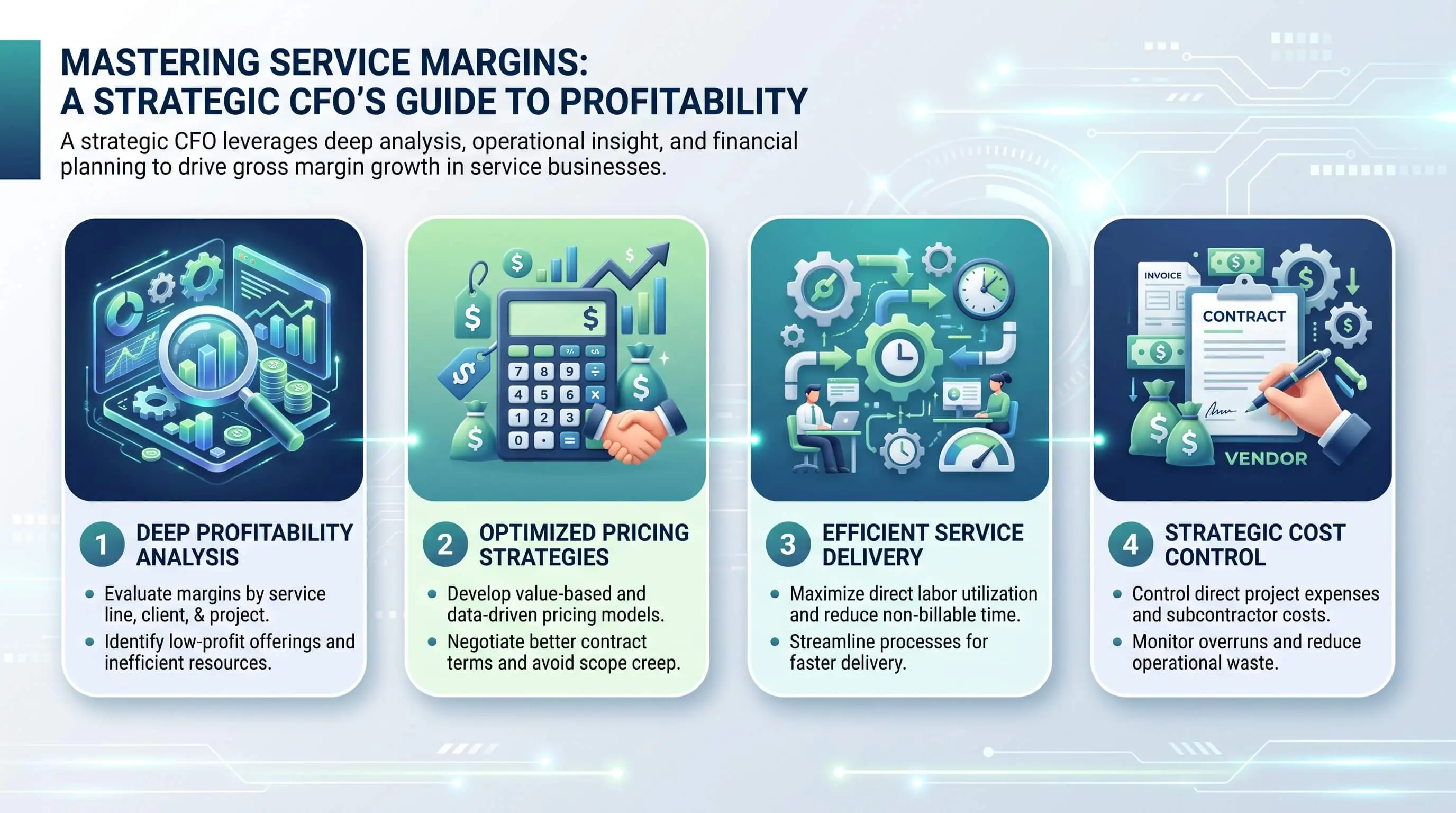
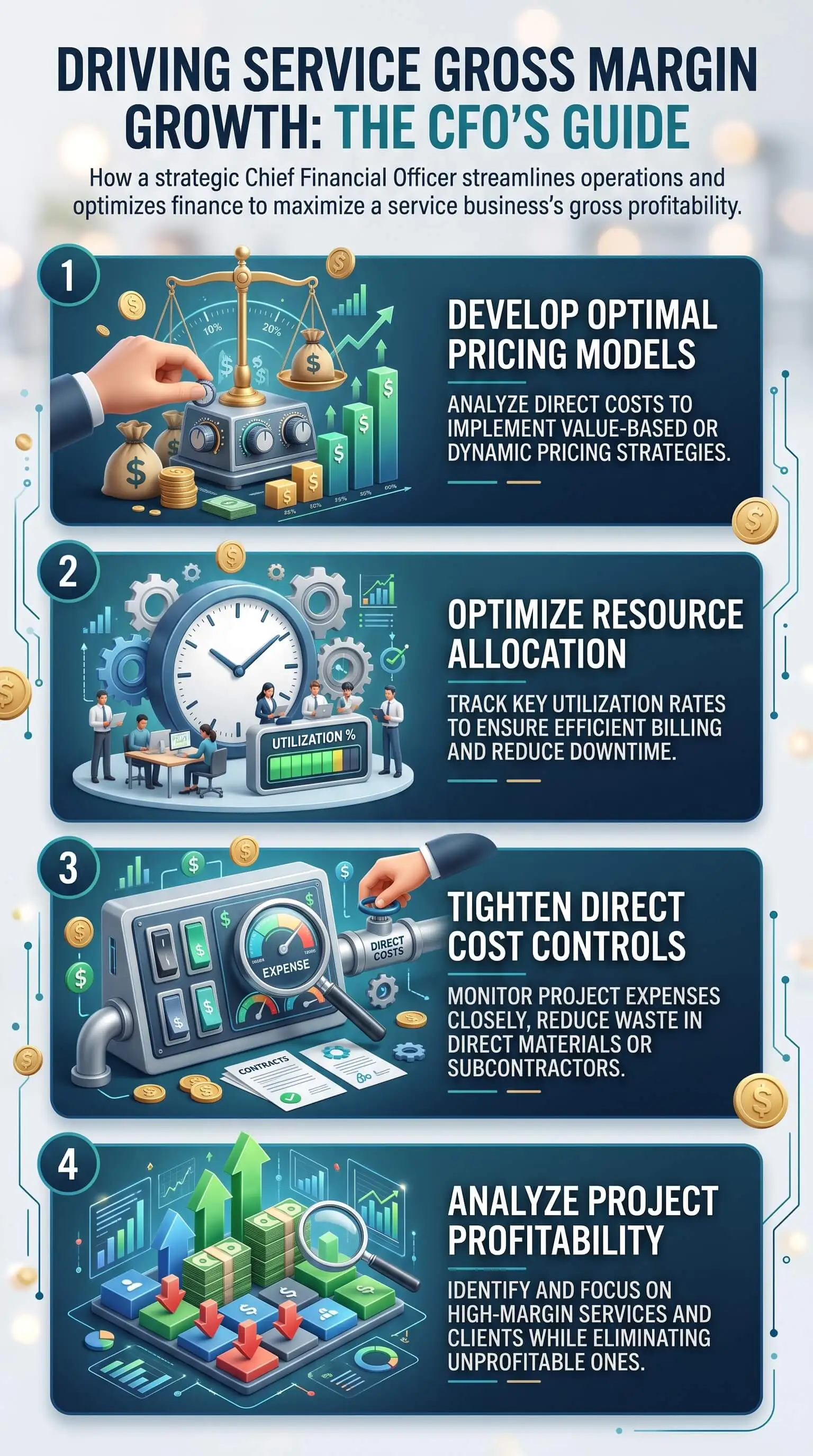
Across-the-board cost cuts rarely fix a margin problem. A CFO starts by making the economics of each service visible, then helps leadership act on what the numbers show.
Calculate Fully Loaded Labor Cost
Start with what an hour of each person's time actually costs. Add salary, payroll taxes, benefits, and paid time off, then divide by the hours that person is available for client work. Owners are usually surprised by how high that number comes in, and every pricing decision after it depends on getting it right.
Price Services to a Target Margin
Once you know labor cost, pricing turns into arithmetic. Here's a simple example:
Current pricing: A $75 fully loaded hourly cost across 40 hours creates $3,000 in direct cost. At a $6,000 price, gross margin is 50%.
Target pricing: The same $3,000 in direct cost, priced at $7,500, produces a 60% gross margin.
The project uses the same hours and the same team. Only the price changed, because it now starts from true cost and works toward a target margin. A CFO can build that logic into a pricing model your team uses on every proposal.
Measure Margin by Client, Service Line, and Project
One company-wide margin number hides a lot. Job costing and client profitability reports show which engagements earn their keep and which ones eat capacity. Job costing was a core part of our fractional CFO work with Quality Roofing, a growing family business, and it gave leadership a much clearer read on where profit was coming from. None of this works on messy books, which is why clean, separated business finances come first.
Improve Utilization and Staffing Mix
A CFO tracks billable and non-billable hours against a target. When utilization runs low, the fix might be tighter scheduling, fewer internal meetings, or a different mix of senior and junior staff. Matching each task to the lowest-cost person who can do it well protects margin without cutting corners.
Control Scope Creep and Direct Costs
Small rules do a lot of work here. Put change orders in writing. Review contractor rates once a year, and bill clients for the software and materials their projects use. None of it is dramatic, but over twelve months it adds up.
Turn Margin Data into KPIs and Forecasts
Margin gains stick when someone keeps watching them. We set up a monthly dashboard that tracks gross margin percentage, utilization, and effective hourly rate, then pairs it with rolling forecasts and scenario planning. Leadership spots a margin problem forming in March instead of reading about it at tax time.
Fractional, Part-Time, or Full-Time CFO: Which Fits a Service Business?
Cost: Accountix fractional CFO services start at $350 per week. A full-time CFO can cost over $200,000 in salary alone.
Time commitment: A fractional or virtual CFO scales with your needs, from a few hours a month to ongoing involvement. A full-time CFO works in-house every day.
Focus: Fractional support concentrates on pricing, margins, forecasting, cash flow, and major decisions. A full-time CFO runs the entire finance function.
Best fit: Fractional suits growing service firms that need strategy without another large salary. Full-time makes sense for larger organizations with complex, daily finance leadership needs.
For most small and midsize service firms, we'd recommend fractional. A full-time hire makes sense once the finance function genuinely needs someone leading it every day.
When to Hire a Fractional CFO
These are the signs we look for:
Revenue is growing, but profit isn't keeping pace.
Prices are set by gut feel or by matching competitors.
You can't say which clients or services are most profitable.
Cash feels tight even when the team is fully booked.
A big decision is coming, such as a key hire, a new location, or outside funding.
When you set out to hire the best virtual, fractional, or part-time CFO services, look for experience with service businesses and hands-on skill in job costing and margin analysis. You'll also want a team that keeps your day-to-day accounting clean underneath the strategy. And ask about reporting rhythm, because monthly reviews beat quarterly surprises.
"When a service firm calls us about margin, the team is almost never the problem. They're working hard. What's missing is visibility. In most of our reviews, the owner has never seen profit broken out by client or service line, and nobody has touched pricing since the last round of raises. Once we calculate fully loaded labor cost and put client margins on a single page, the decisions get a lot easier. Owners reprice some work and restructure the rest. Every so often they let a client go, and they're usually relieved."
7 Essential Resources
We point clients to these when they want to check our math or dig further on their own.
U.S. Small Business Administration: Manage Your Finances
The SBA's guide covers bookkeeping basics, financial statements, and how to separate and analyze different parts of your business. Breaking the business into segments is the first step toward seeing margin by service line. Visit the SBA guide
SCORE: Financial Management Workbook
A practical primer on reading income statements, managing cash flow, and seeing how everyday decisions hit profit. Owners who work through it tend to get more out of their CFO conversations. Open the SCORE workbook
U.S. Bureau of Labor Statistics: Employer Costs for Employee Compensation
The BLS publishes quarterly data on what employers spend on wages and benefits per hour worked. Use it to sanity-check your own fully loaded labor cost. Explore BLS compensation data
Corporate Finance Institute: Gross Margin Ratio Calculator
CFI's free spreadsheet template calculates gross margin from revenue and direct costs. Set it up once per client or project and you have a starting point for tracking. Download the CFI template
AccountingTools: Gross Margin Explained
A plain explanation of the gross margin formula, why net sales matter, and how to read margin trends over time. It's handy for deciding when a dip deserves a closer look. Read the AccountingTools guide
McKinsey & Company: The Power of Pricing
McKinsey's article on transaction pricing shows how discounts and concessions chip away at the price a business actually collects. Anyone who negotiates project fees will recognize the pattern. Read the McKinsey article
SPI Research: Professional Services Maturity Model
SPI Research's framework lets service organizations benchmark utilization, project margin, and operational maturity against peers. It's a useful gut check on what high-performing firms do differently. Explore the SPI model
Mission-driven organizations can apply the same habits. This guide to accounting support for nonprofits covers how.
These resources give business owners practical ways to understand bookkeeping, cash flow, labor costs, pricing, and profit margins, while virtual outsourced finance and accounting services online can help turn that financial information into clearer service-line analysis and better business decisions.
3 Statistics
These numbers line up closely with what we see in service firms every month.
Benefits make up 30% of what employers spend on labor
Private industry employers spent an average of $46.89 per hour working on employee compensation in June 2026, according to the U.S. Bureau of Labor Statistics. Benefits made up $14.07 of that, or 30.0%. Put another way, benefits added roughly 43% on top of wages. A firm that prices from salary alone is underestimating its delivery cost by a wide margin. Source: BLS Employer Costs for Employee Compensation, June 2026
Billable utilization hit a record low of 66.4%
The 2026 SPI Professional Services Maturity Benchmark, summarized by Deltek, found that billable utilization fell to 66.4% in 2025. That's the lowest level in SPI's survey history and well under the 75% threshold SPI considers optimal. Every unbilled hour still lands in cost of services. Source: Deltek summary of the 2026 SPI Professional Services Maturity Benchmark
Service industries typically keep about a third of revenue as gross margin
NYU Stern professor Aswath Damodaran's January 2026 dataset of U.S. public companies puts average gross margin at 36.24% for advertising firms and 33.38% for business and consumer services. Smaller private firms won't match those figures exactly. Still, they show how little room there is for error once delivery labor is counted correctly. Source: NYU Stern, Margins by Sector (US)
Our reading is simple. If you price from salary and assume everyone bills most of the week, your margin on paper is probably higher than your margin in the bank.
Final Thoughts and Opinion
We'd argue gross margin should be set on purpose, at the proposal stage. Too many owners find out how profitable last year was when the tax return shows up. By then the underpriced projects are finished and the unbilled hours are gone for good.
The service firms we see holding healthy margins aren't always bigger or more specialized. They look at their numbers sooner, and they look more often, often with support from outsourced business and financial accounting firms.
What We See Most Often
Owners copying rates from competitors instead of building them from delivery cost
Delivery labor sitting in overhead, which flatters the margin
One or two clients taking far more time than their fees cover
Teams treating scope changes as favors instead of billable work
Why It Matters
Revenue growth can hide shrinking profit for a year or longer.
Thin margins leave little to reinvest in people, tools, or marketing, and cash gets tight even when the calendar is full.
What High-Margin Service Firms Do Differently
They calculate fully loaded labor costs and update it whenever pay or benefits change.
They price every proposal against a target margin.
Leadership reviews client and project profitability every month.
They bill scope changes by default.
Someone owns the numbers, whether that's an in-house finance lead or a fractional CFO.
The Bottom Line
Most margin problems come down to not seeing the numbers clearly. A CFO, fractional or full-time, brings the structure that turns a busy month into a profitable one.
Frequently Asked Questions
What is a good gross margin for a service business?
There's no single number, because industry, pricing model, and cost classification all move it. For reference, NYU Stern's January 2026 data puts U.S. public advertising firms at about 36% and business and consumer services at about 33%, which can also provide useful context for firms working in multicultural marketing. The benchmark we care about more is your own target margin, set high enough to cover overhead and still leave profit.
What is the difference between gross margin and gross profit?
Gross profit is a dollar figure: revenue minus cost of services. Gross margin is that figure as a percentage of revenue. A firm with $1 million in revenue and $600,000 in delivery costs has $400,000 in gross profit and a 40% gross margin.
Can a CFO improve gross margin without raising prices?
Yes. Better utilization, the right staffing mix, tighter scope control, billing for pass-through costs, and dropping unprofitable clients can all lift margins. Pricing usually plays a part, but it's rarely the only lever we pull.
How much do fractional CFO services cost?
At Accountix Solutions, fractional CFO services start at $350 per week, with final pricing based on your company's stage and complexity. Compare that with a full-time CFO, where salary alone can top $200,000.
How long does it take to see gross margin improvements?
Repricing new proposals and billing for scope changes can show up within a billing cycle or two. Structural fixes, like raising utilization or restructuring client accounts, usually take a few quarters. Tracking margin monthly lets you see progress early.
Is a virtual CFO the same as a fractional CFO?
The terms overlap. A fractional CFO works part-time for your business, and a virtual CFO works remotely. Many fractional CFOs are virtual too, working through video calls, shared dashboards, and messaging tools instead of sitting in your office.
Find Out Where Your Margin Is Going
When the team is busier than ever and profit isn't keeping up, start with a clear look at your numbers. Business owners ready to hire the best virtual or part-time CFO services, alongside remote outsourced QuickBooks bookkeeping services, can book a 30-minute intro call with the Accountix Solutions fractional CFO team. No obligation, just clarity on where your margin stands and what to fix first.