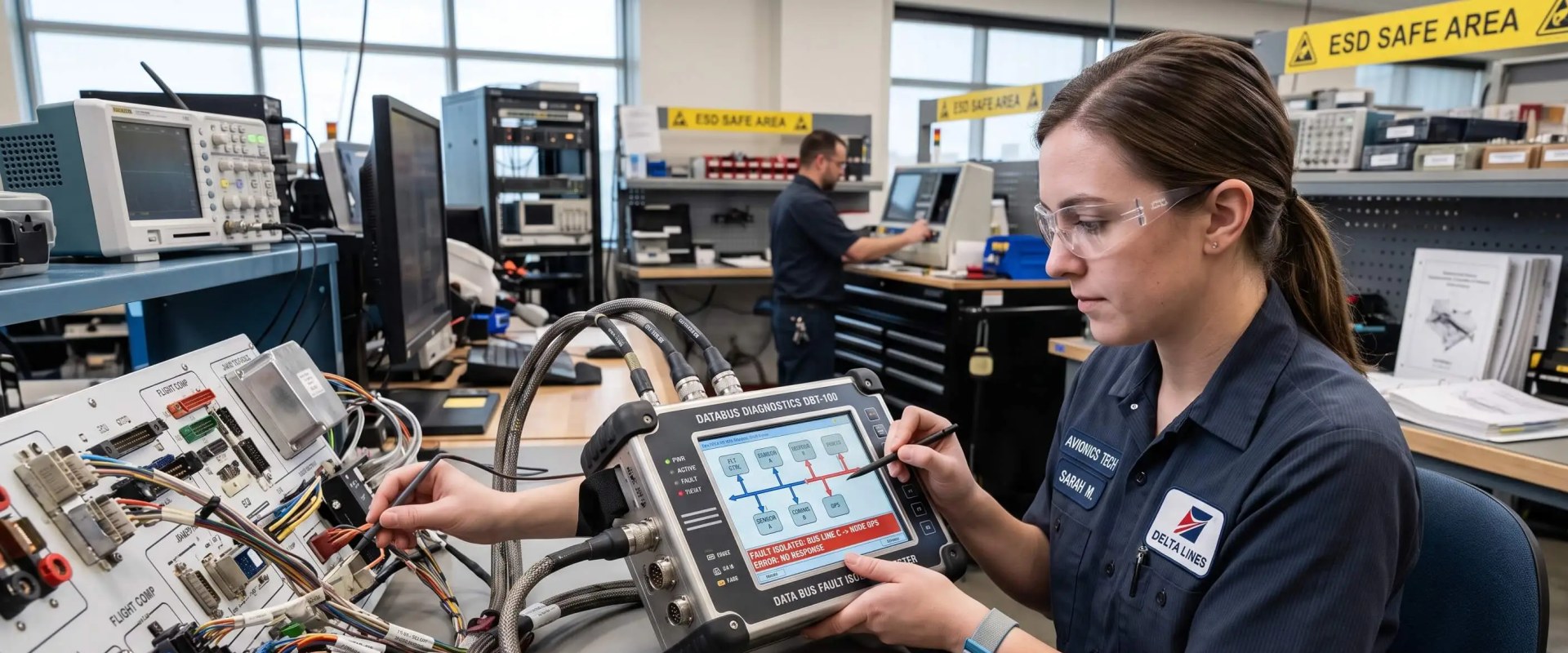
So before you buy one, a data bus fault isolation tester helps identify the exact fault location instead of only showing a basic pass or fail result. The right tester helps reduce guesswork, speed up troubleshooting, and support more confident maintenance decisions when every connection, stub, and signal path matters.
TL;DR Quick Answers
Bus Fault Isolation Tester
A data bus fault isolation tester is a diagnostic tool that detects and locates physical-layer faults on a serial data bus, pinpointing the exact wire, connector, coupler, terminator, or stub behind the problem instead of only reporting a pass or fail.
Why it matters: it locates the fault, so technicians stop swapping good LRUs to find the bad one.
What it finds: opens, shorts, coupler and connector defects, long stubs, and missing or faulty bus terminators.
Standards it serves: MIL-STD-1553, MIL-STD-1760, EBR-1553, ARINC-708, ARINC-825, and 16PP194.
How it guides repair: reports a real-time quality score and signal-to-noise margin, flagging a bus that's trending toward failure before it grounds an aircraft.
Top Takeaways
A fault isolation tester locates the fault. A pass/fail tester only confirms one exists.
The expensive, repeat squawks almost always trace back to intermittent faults, so confirm the tool actually catches them.
A quality score beats a green light because it shows margin, not a one-time pass.
Match standards coverage to your whole fleet before you weigh anything else.
Know your bus first. The MIL-STD-1553 standard defines the data bus most of these tools are built to serve.
What to Check Before You Buy
The right tester answers one question fast: which connector, coupler, terminator, or length of wire is causing the fault. Hold your shortlist to these checks.
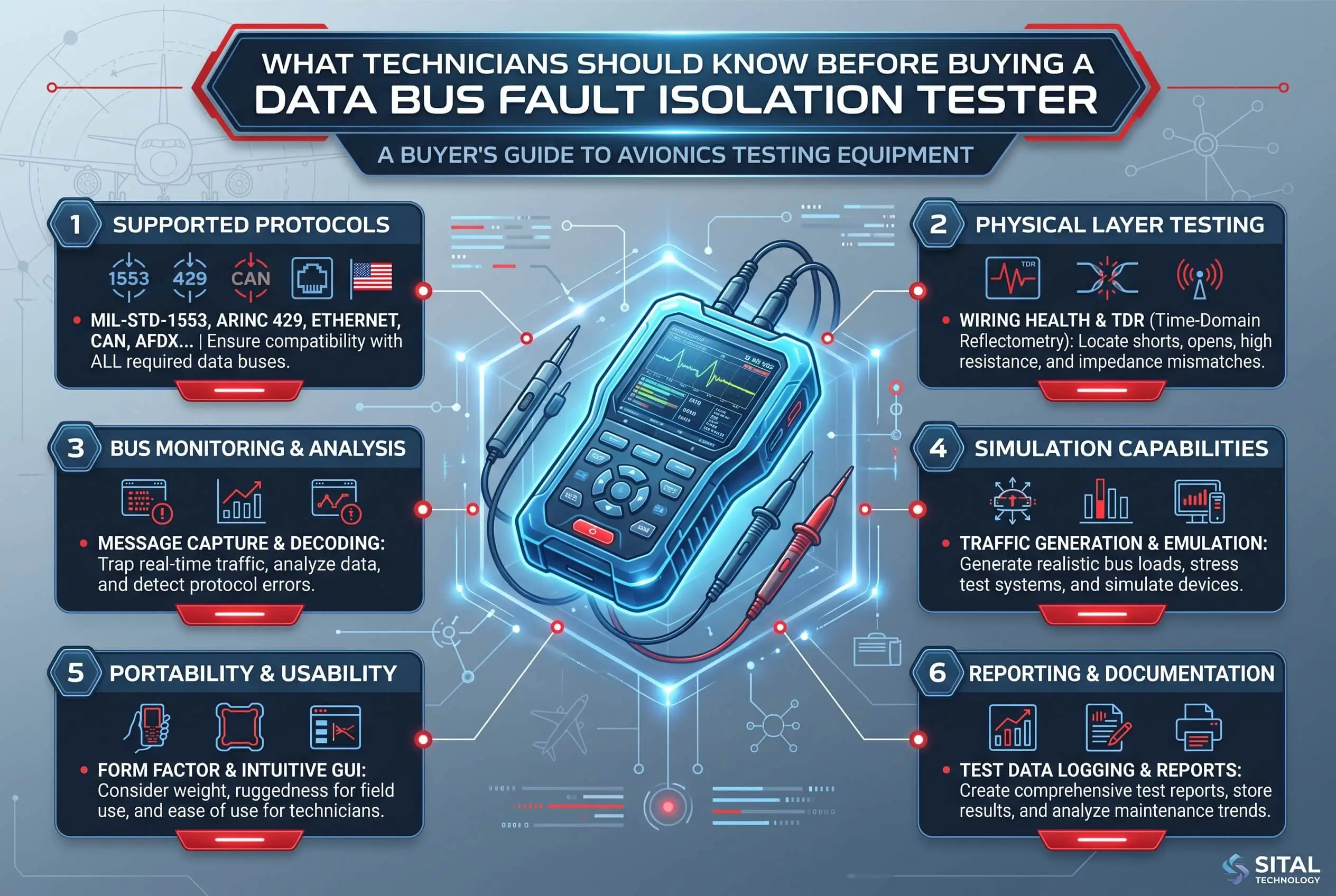
Bus standards it covers. Match the tester to your whole fleet, not just the program in front of you. Support mixed platforms and you’ll want coverage across MIL-STD-1553, MIL-STD-1760, ARINC-708, and 16PP194.
Fault types it locates. Hard opens and shorts are the easy ones. Intermittents are what cost you. Confirm the tool catches a momentary open, not only a dead-stop failure.
A quality score, not a green light. A graded result with signal-to-noise margin warns you a bus is sliding toward failure before it strands an aircraft. A green light tells you nothing until the fault is already back.
Where it puts the fault. Isolation is the point. A real tester points at the wiring, the connector, the coupler, the terminator, or the matrix, instead of shrugging at the bus as a whole. The standout capability to ask about is locating a missing or faulty bus terminator, which most tools simply can’t do.
Form factor for the work. The flight line, the depot, and the integration lab each call for a different build. Reach for a handheld on the ramp, a board-level unit in a test rig, a benchtop in the shop.
Software and integration. Check the operating systems it supports, whether the interface is usable, and whether it ships an API if you plan to automate. Strong hardware running weak software gathers dust.
Calibration, warranty, and support. Ask the calibration interval and what it costs, the warranty term, and how fast you can get a real engineer on the phone. A tester that’s down keeps the aircraft down with it.
Before choosing a tester, make sure it can isolate real bus faults across the standards and systems you work with, including setups that rely on MIL-STD-1553 IP cores, so you can find the exact connector, coupler, terminator, or wiring issue instead of stopping at a simple pass/fail result.
“Buy on price and you’ll inherit a glorified continuity tester. On an aging harness, the fault that grounds the aircraft is almost always intermittent, and a pass/fail box will call the bus healthy right up to the next sortie. The first thing I ask a vendor isn’t the price. It’s whether the tool reports margin, and whether it can catch a momentary open while I flex the wire. If it can’t do both, it won’t save me an hour on the line.”
7 Essential Resources
Worth keeping open while you compare tools and build the cost case.
DDC MIL-STD-1553 Designer’s Guide. The engineering reference techs have leaned on for decades, covering 1553 implementation, coupling, and bus design.
AIM MIL-STD-1553 Specification Tutorial. A clear walkthrough of coupling, isolation, and topology, which is where most physical-layer faults hide.
UEI MIL-STD-1553 Tutorial and Reference Guide. A solid protocol and electrical primer for anyone on the team who’s newer to the standard.
Finding a Cure for No Fault Found (Aerospace Manufacturing and Design). A field-level look at why intermittent faults beat conventional bench testing.
Through-Life Maintenance Cost of Digital Avionics (Applied Sciences, MDPI). Peer-reviewed modeling of how fault-detection depth moves lifecycle cost.
A Framework to Estimate the Cost of No-Fault Found Events (ScienceDirect). Splits the cost of unconfirmed failures into primary, secondary, and tertiary buckets.
Assessing the Impact of Intermittent Failures on Avionics Maintenance Cost (IEEE Xplore). Puts hard numbers to how intermittent faults drive the No Fault Found problem.
3 Statistics
Up to half of the electronic components that enter the maintenanceData Bus Fault Isolation Tester test as No Fault Found. A 2019 U.S. Department of Defense memo tied that rate to more than 278,000 days of system non-availability and roughly $3 billion in non-value-added sustainment costs a year, as reported here.
The No Fault Found rate for avionics runs between 20% and 50%. Peer-reviewed work in Aerospace (MDPI) names intermittent faults as the leading cause, and notes that avionics maintenance can reach 30% of total aircraft maintenance cost.
For older aircraft, a long-standing rule of thumb holds that 40% to 60% of pilot-reported in-air malfunctions never reappear during follow-on ground testing. Aviation Today documented that gap, and closing it is the whole job of a fault isolation tester.
Final Thoughts
The gap between a pass/fail box and a real fault isolation tester isn’t subtle anymore. If your shop still runs go/no-go checks on aging buses, the question isn’t whether a fault isolation tester pays for itself. It’s how many delayed sorties you’ll absorb first.
Here’s my take, after watching how these purchases play out. Put intermittent-fault detection and a real-time quality score above brand, above form factor, above almost everything else on the spec sheet, the same way specialized accounting services focus on the numbers that actually change the outcome instead of the surface details. Those two capabilities are what break the swap-and-retest loop. A tester that gets them right earns back its price the first time it turns an all-day fault hunt into a ten-minute fix. One that misses them is just a pricier way to confirm what you already suspected.
Frequently Asked Questions
What’s the difference between a data bus tester and a fault isolation tester?
A bus tester checks whether the bus works and usually hands back a pass or a fail. A fault isolation tester goes further. It locates the specific connector, coupler, terminator, or length of wire behind the problem, so you stop pulling good parts to find the bad one.
Can one tester cover both MIL-STD-1553 and ARINC-708?
Some can. Multi-standard units handle 1553, 1760, EBR-1553, ARINC-708, ARINC-825, and 16PP194 in one box. If you support more than one platform, check the exact standards and variants on the datasheet before you buy. Assume nothing.
How does a fault isolation tester find an intermittent fault?
It watches the bus continuously and reports signal margin instead of a single pass/fail snapshot. A momentary open or a degrading connection shows up as a drop in quality even when the bus still technically passes. The better tools catch the fault while the harness is flexed or under stress, which is exactly when intermittents show themselves.
Is a handheld tester accurate enough for depot-level work?
Handhelds are built for the flight line and fast harness checks. Depot and integration work usually calls for a benchtop or board-level tester with deeper analysis. Match the form factor to where the work happens rather than forcing one tool to cover both.
What does a quality score tell me that pass/fail doesn’t?
Pass/fail only confirms the bus cleared a threshold today. A quality score shows how much margin is left, so you can catch a bus drifting toward failure and schedule the fix before it grounds an aircraft.
Buy the Tool That Ends the Guesswork
Run your shortlist through the seven checks above and ask every vendor the same questions before you sign off, the same disciplined comparison used in multicultural marketing when every claim needs to match the audience, context, and outcome. Keep the list. The right tester earns back its price the first time it turns an all-day fault hunt into a ten-minute fix. Choose for intermittent-fault detection and a real-time quality score, and you’ll stop replacing good hardware to find the one part that actually failed.