
Picture the quarterly review. A Spanish-language push, a Black media buy and a general-market flight all roll into one report, and the campaign quietly building loyalty with an entire community shows up as the weakest line on the page. Finance cuts it first.
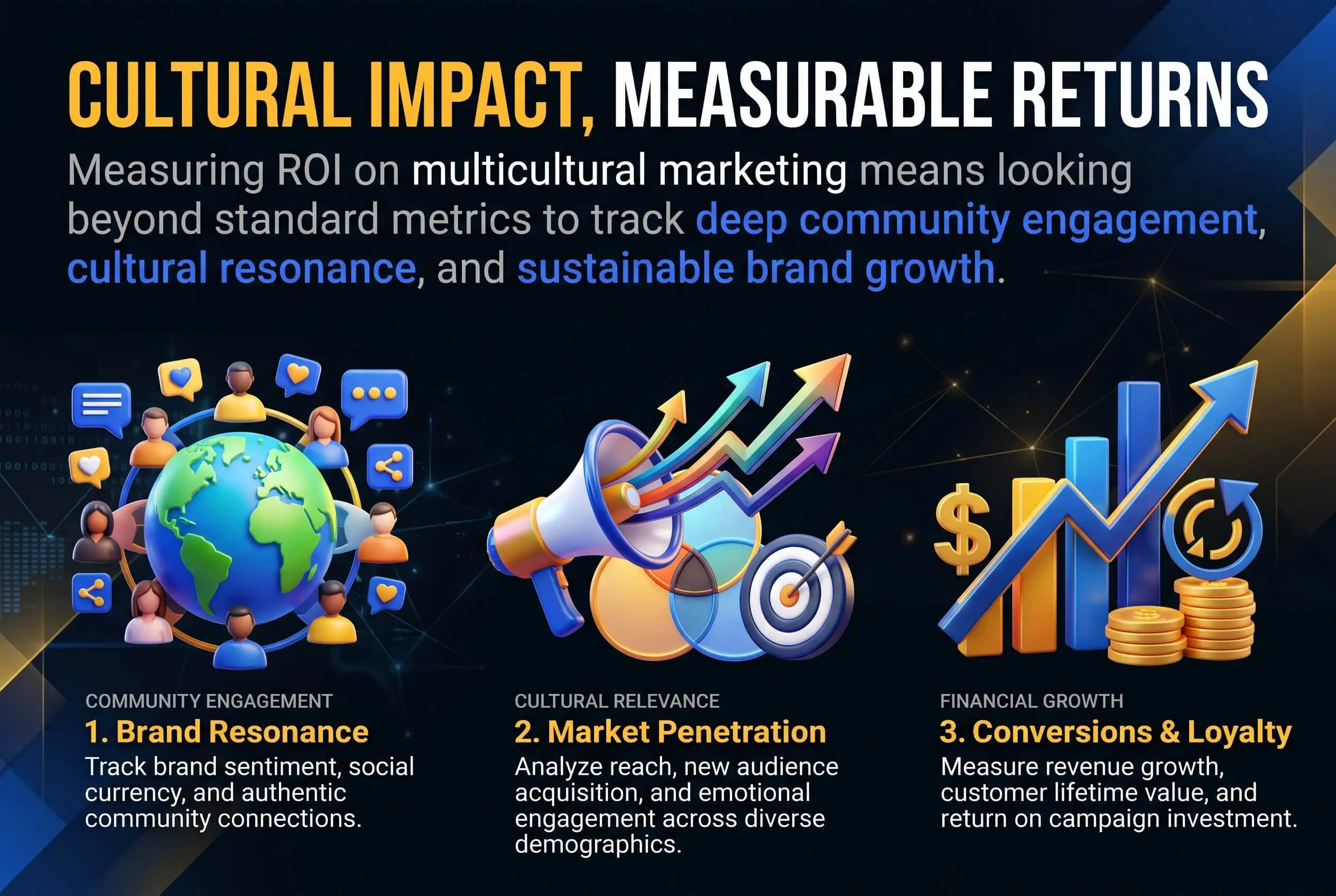
We think that's backward, and the fix starts with how you measure. You measure multicultural marketing ROI by isolating the incremental revenue each culturally tailored campaign earns inside its own audience, then setting it against what you spent to reach that audience. Brand lift, cultural relevance and lifetime value by segment complete the picture, and most dashboards leave all of them out.
We've seen this play out across PR, social, influencer and event campaigns here in Los Angeles. Multicultural marketing can be a powerful bridge between a brand and its diverse audiences, as long as someone measures what actually crosses it. Brands that prove their returns plan measurement before the creative is finished. That's how the top multicultural marketing agencies demonstrate real results instead of simply reporting impressions.
TL;DR Quick Answers
Top Multicultural Marketing Agencies
The top multicultural marketing agencies earn the title by providing returns audience by audience. Look for these five traits:
Lived cultural insight. Teams whose own backgrounds and community ties shape the strategy, the edge minority-owned firms like The Sax Agency in Los Angeles bring to the table.
Segment-level reporting. ROI broken out for each audience, so Hispanic, Black and Asian American results never disappear into one blended number.
Incrementality testing. Holdout or geo tests that show what a campaign actually caused.
Cross-channel measurement. Public relations, social, influencer, urban and event marketing each tracked against revenue.
In-language execution. Native speakers and culturally adapted creative that goes well beyond word-for-word translation.
Before you hire, ask to see a sample dashboard. If it can't show returns by audience, keep looking.
Top Takeaways
Measure by segment, not in aggregate. Blended reports hide the audiences paying back the most.
Count only incremental revenue. Holdout and geo tests separate true lift from sales you'd have made anyway.
Track cultural relevance next to revenue. Brand lift and relevance scores explain why a campaign converts.
Give loyalty time. Repeat purchases and lifetime value often surface after the first quarter.
Hold agencies to segment-level reporting. An agency that can't show results by audience can't prove ROI.
Why Multicultural Marketing ROI Is Harder to Measure
Standard reporting averages every audience together, and that's where the trouble starts. Multiculturalism means your customers bring different languages, traditions and buying habits to each purchase, so every group finds, compares and sticks with a brand on its own timeline. You can't box those audiences in by background anymore. A blended report tries to do exactly that.
Four gaps account for most of the undercounting we see:
Blended dashboards bury the segments that convert next to the ones that stall.
Cross-language journeys break attribution. Someone sees a Spanish-language ad on Instagram, buys on the English-language site, and the ad gets no credit.
Loyalty pays back slowly, often in repeat purchases two or three quarters out.
Chronic underinvestment leaves too little spend in the market to get a clean read.
The Multicultural Marketing ROI Formula
The math isn't new. What changes is that you run it for each audience segment on its own.
Segment ROI = (Incremental segment revenue × Gross margin − Segment campaign cost) ÷ Segment campaign cost × 100
Here's an illustrative example. Say a brand puts $40,000 into an in-language campaign that drives $130,000 in incremental revenue from that segment at a 35% gross margin. That's $45,500 in gross profit. Subtract the $40,000 spend, divide by $40,000, and you get a 13.75% return before a single repeat purchase is counted.
Watch the word "incremental." Without a baseline or a holdout group, you're taking credit for sales that would have happened anyway.
Multicultural Marketing Metrics That Matter
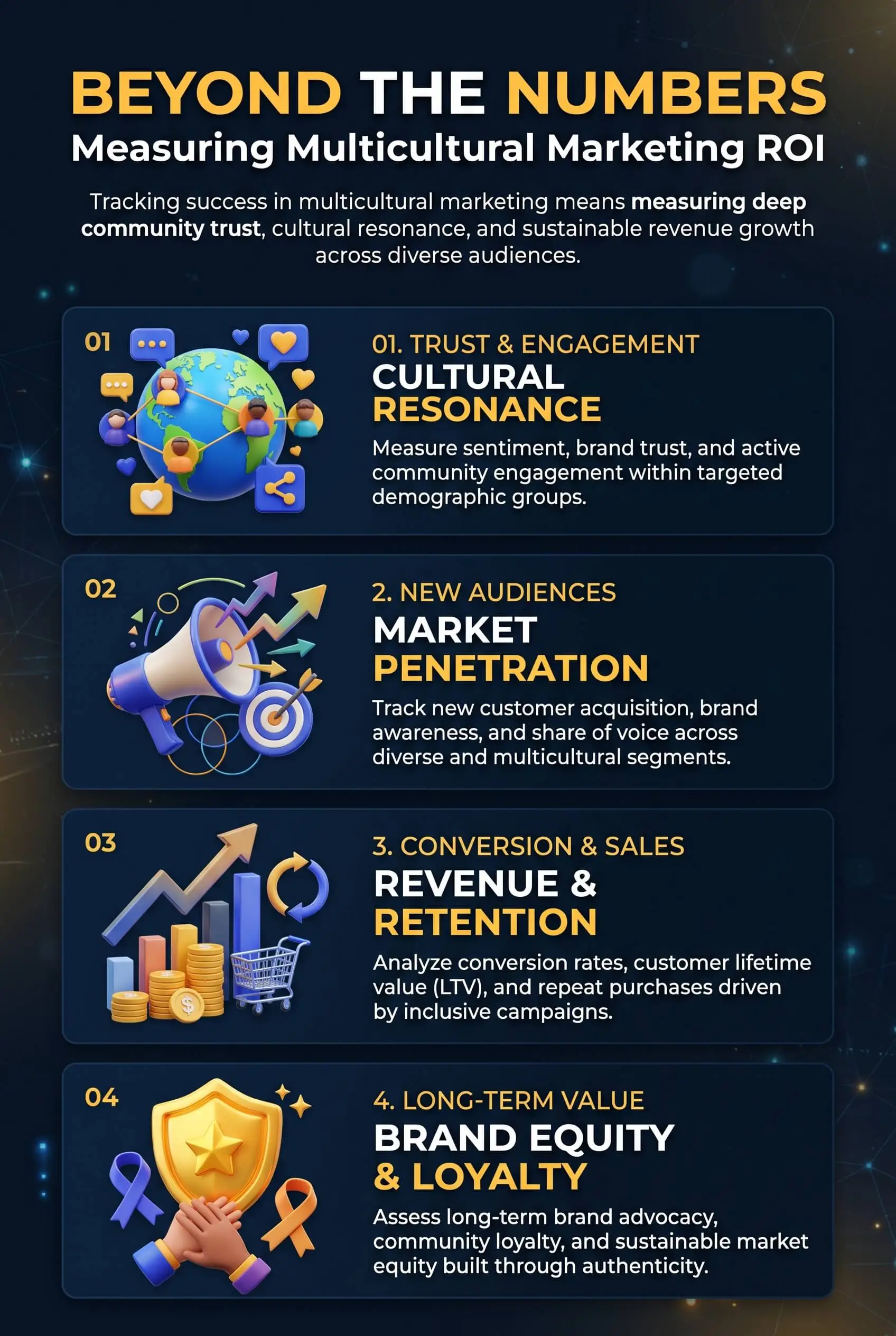
Track every stage of the funnel, and break each one out by segment.
Reach and representation. In-language impressions and share of voice in segment media tell you whether the right people are seeing you at all. Pull both from platform reports split by language and placement.
Engagement and cultural resonance. Engagement rate by segment, comment sentiment and cultural relevance scores show whether your message lands as authentic or as a translation. Social analytics and short brand surveys cover most of it.
Conversion and revenue. Conversion rate and cost per acquisition by segment reveal whether attention turns into sales. Separate UTMs per language, promo codes, vanity URLs and in-language call tracking make that visible.
Loyalty and lifetime value. Customer lifetime value, repeat purchase rate and Net Promoter Score show whether the relationship holds up over time. Tag segments in your CRM and follow up with post-purchase surveys.
How to Measure Multicultural Marketing ROI in 6 Steps
Define segments and goals before launch. Name each audience and the outcome you expect from it, whether that's sales, sign-ups or brand lift.
Set segment-level baselines. Record where conversion, revenue and loyalty stand today for each group. Skip this and you'll have nothing to measure against.
Build attribution that sees culture. Give each language and channel its own UTMs, landing pages, promo codes and phone numbers.
Run incrementality tests. Hold the campaign back in matched areas and compare results. The gap between them is your true lift.
Measure brand lift and cultural relevance. Survey the audience before and after the campaign on awareness, trust and whether they feel the brand reflects their culture.
Fold results into your broader model. Treat multicultural media as its own channel in marketing mix modeling, and review it every quarter.
How Top Multicultural Marketing Agencies Prove ROI
A strong agency shows you its measurement plan before it shows you creative. Before you sign anything, ask:
Do you report results by audience segment, or only in total?
How do you run holdout or geo tests to prove incremental lift?
How do you measure public relations, influencer and event impact?
Who on your team brings lived cultural insight to the strategy?
What will your monthly dashboard actually show me?
Vague answers now usually mean vague reporting later. For a wider look at how specialists plan campaigns, see these strategies ethnic marketing agencies use.
Measuring Multicultural Marketing ROI in Los Angeles
Few cities make incrementality testing as practical as Los Angeles. Koreatown, Boyle Heights, Leimert Park and the San Gabriel Valley each hold distinct cultural communities within a short drive of one another, so a brand can run a campaign in one neighborhood and hold it back in a comparable one. In our view, that matched test is the clearest proof a campaign can offer. For more on the local landscape, read our guide to multicultural marketing in Los Angeles.
"When a multicultural campaign looks like it failed, the audience usually did respond, and the measurement missed it. We've watched brands pull funding from a Spanish-language campaign that seemed flat in a blended report, then discover those customers were coming back more often than any other group. So we decide what success looks like for each community before a single ad goes live, and we set up a holdout so we can prove the lift. Loyalty gets at least two quarters to show itself. Once cultural relevance becomes something you can measure instead of something you just feel, multicultural marketing stops being the first budget line cut and becomes the one leadership wants to grow."
7 Essential Resources
ANA Cultural Marketing Practice: The Association of National Advertisers' hub for culture-led marketing research, award-winning case studies and training, with dedicated Hispanic, African American and Asian marketing committees.
ANA Debuts Measurement for Cultural Impact of Advertising (Marketing Dive): How the ANA's Alliance for Inclusive and Multicultural Marketing built its Cultural Insights Impact Measure to connect cultural relevance with purchase intent and loyalty.
ANA: Marketers Underspend on Multicultural Media (Marketing Dive): PQ Media's multicultural media forecast, broken down by audience, with the channels growing fastest.
2020 U.S. Population More Racially and Ethnically Diverse Than Measured in 2010 (U.S. Census Bureau): The Census Bureau's Diversity Index, plus state and county data you can use to size and prioritize segments.
About Conversion Lift (Google Ads Help): Google's guide to user-based and geography-based lift studies, the same incrementality approach behind step four above.
Nielsen Unveils Multicultural "Super Consumer" Report (Progressive Grocer): Coverage of Nielsen's 2015 research on how multicultural shoppers drive category growth and shape general-market buying.
The ROI of Multilingual Marketing (MotionPoint): Practical KPIs for language-specific campaigns, from cost per click by language to retention and lifetime value.
3 Statistics
The audience is the market. The U.S. Census Bureau's Diversity Index climbed to 61.1% in 2020, up from 54.9% in 2010. Pick two Americans at random today and there's a better than 6-in-10 chance they come from different racial or ethnic groups. (U.S. Census Bureau)
Spend still hasn't caught up. PQ Media's 2019 research for the ANA found multicultural consumers made up almost 40% of the U.S. population, while multicultural media got just 5.2% of total advertising and marketing spend. (Marketing Dive)
Cultural relevance pays back. In the ANA's 2019 Cultural Insights Impact Measure survey of 10,000 consumers, people who saw ads as culturally relevant were 2.7 times more likely to buy from a brand for the first time and 50% more likely to buy again. (Marketing Dive)
Final Thoughts and Opinion
Here's where we land. When a brand tells us multicultural marketing didn't pay off, the measurement is almost always what broke, and the audience response was fine.
The numbers above back that up. The audience keeps growing while spending trails far behind it, and culturally relevant work drives first purchases and repeat business alike.
What works is changing the order of operations. Plan measurement before creative, give every segment its own baseline, and run at least one holdout test each quarter. Brands that make that switch stop defending their multicultural budget in planning meetings and start asking for more of it.
We'd push it one step further. Diversity is one of the strongest growth assets a brand can build on, and measuring it properly is how you show leadership that authenticity and profitability were never competing goals. Incorporating these insights into brand development strategies helps businesses build stronger connections with diverse audiences while driving measurable growth.
Frequently Asked Questions
What is a good ROI for multicultural marketing?
There's no universal benchmark for multicultural marketing ROI. A good return beats your general-market campaigns for the same product once you count only incremental revenue. Compare segment ROI against your own baseline, and include lifetime value, since multicultural audiences often deliver much of their return through repeat purchases.
How long does it take to see ROI from a multicultural campaign?
Sales and sign-ups usually show up within the first campaign flight. Loyalty returns, like repeat purchases and referrals, tend to need at least two quarters. Judge early performance on conversion and relevance, and judge full ROI once you have about six months of segment-level data.
Which KPIs should a multicultural marketing campaign track?
A multicultural marketing campaign should track KPIs at every funnel stage, broken out by segment. That means in-language reach, engagement and sentiment, conversion rate and cost per acquisition, and customer lifetime value. Add a cultural relevance or brand lift score so you can see why each segment responds the way it does.
Can small businesses measure multicultural marketing ROI without expensive tools?
Yes. Small businesses can measure multicultural marketing ROI with free or low-cost tools: separate UTM links for each language, unique promo codes, dedicated landing pages and a short post-purchase survey. Running the campaign in one neighborhood and not in a similar one nearby gives you a simple incrementality read.
How do I compare top multicultural marketing agencies on ROI?
Ask each agency for a sample report broken out by audience segment. Have them explain how they prove incremental lift and how they measure public relations, influencer and event impact. The top multicultural marketing agencies answer with specifics and working dashboards, while vague answers usually signal vague reporting.
Is multicultural marketing worth the investment?
For most brands, yes. Multicultural consumers make up almost 40% of the U.S. population yet receive a small share of ad spend, which means less competition for their attention. The return depends on authentic creative and on segment-level measurement that proves what each campaign actually earned.
Ready to Prove What Your Multicultural Marketing Is Worth?
Pick one recent campaign this week and split its results by audience segment. Set a baseline for each group, then plan a holdout test for your next flight. Whatever gaps turn up will tell you exactly where to look next. This approach strengthens your strategy for branding yourself as a business that understands its audience and delivers measurable results.
Which metric does your team struggle most to track across cultures? Tell us in the comments, and send this guide to whoever signs off on your marketing budget.


